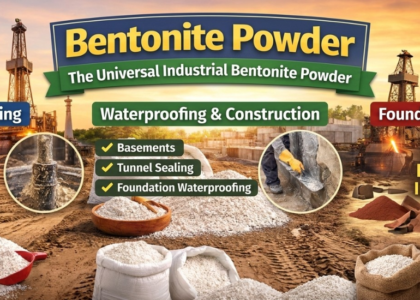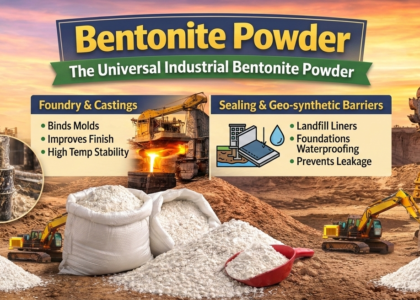
Bentonite is widely used in construction and waterproofing because of its ability to absorb water, swell, and form an impermeable seal. When Bentonite comes into contact with moisture, it expands and blocks the flow of water, making it ideal for protecting foundations, basements, tunnels, and ponds from leakage.
Uses of Bentonite in Construction & Waterproofing
1. Waterproofing Membranes
Bentonite is used in GCL (Geosynthetic Clay Liners) and waterproofing sheets.
These membranes are installed below buildings, in basements, and under concrete slabs.
When they get wet, Bentonite swells and creates a tight seal that stops water from entering.
2. Diaphragm Walls & Pile Foundations
In deep construction like bridges and high-rise buildings, Bentonite slurry is used to stabilize the soil and prevent the walls from collapsing during excavation.
3. Tunnel and Subway Construction
Bentonite helps maintain safe pressure and prevents water seepage from surrounding ground layers.
4. Pond, Lake & Canal Lining
Bentonite is applied as a powder or mixed soil layer to seal ponds, artificial lakes, fish farms, and canals, preventing water loss.
5. Grouting & Soil Sealing
It is mixed with cement or polymers to fill cracks, stabilize weak soil, and control seepage in dams and underground structures.
Why Bentonite is Effective in Waterproofing
-
Expands 15–20 times when wet
-
Creates a waterproof barrier naturally
-
Self-healing ability: seals small cracks automatically
-
Long-lasting and eco-friendly
-
Safe alternative to chemical waterproofing materials
What is Bentonite Powder? Properties, Types & Industrial Uses Explained
Why is Bentonite used for wastewater treatment and purification?
Which lime is used in AAC block manufacturing?
Why Calcium Carbonate Is Used in Toothpaste & Cosmetics?
Why Lime Is Essential in Building Materials Manufacturing?
Why is Bentonite used for wastewater treatment and purification?